Female carpenter bees bore clean 0.5-inch diameter entry holes into exposed framing, carving horizontal nesting tunnels 6 to 10 inches along the wood grain. This nesting pattern weakens load-bearing roof eaves and…
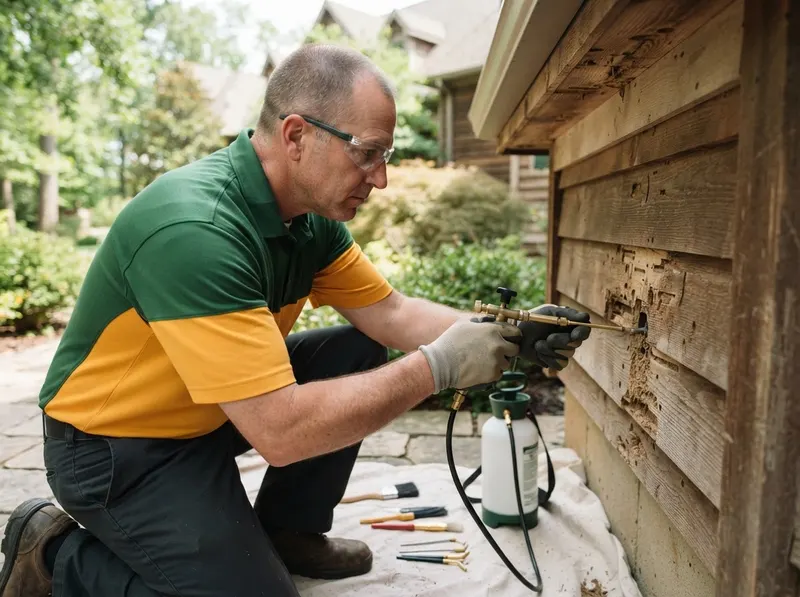
Female carpenter bees bore clean 0.5-inch diameter entry holes into exposed framing, carving horizontal nesting tunnels 6 to 10 inches along the wood grain. This nesting pattern weakens load-bearing roof eaves and invites secondary foraging damage from woodpeckers seeking larvae. In historic neighborhoods like Shandon, Earlewood, and Elmwood Park, historic heart pine and cedar soffits remain vulnerable each spring when ambient temperatures consistently reach 60°F. Rather than dousing yards in broadcast chemicals, professional exclusion protocols focus on insect biology, delivering measured active botanicals and pyrethroid dusts into existing nesting chambers. This stops the lifecycle inside the gallery, safeguarding indoor pets and young children from broad-spectrum overspray. BrightOak Pest Elimination protects structures by neutralizing active chambers, clearing nested frass, and mechanically sealing every hole with hardwood plugs and weather-resistant sealants so secondary pests cannot reoccupy the tunnel.
Homeowners in Rosewood, Forest Acres, and Lake Katherine frequently deliberate between hardware store liquid sprays and dedicated physical exclusion. Over-the-counter insecticides kill single flying adults on direct contact but dissipate within days, leaving the inner egg chambers viable and wood fiber unprotected. Physical wood protection repairs existing bore pathways and seals open grain against spring reinfestation. If damage is confined to a ground-level deck railing or a 10-foot stretch of fascia board, a localized gallery treatment and dowel seal resolves the issue; if untreated carpenter bee galleries span a 200-linear-foot perimeter on a two-story home in Heathwood or The Vista, the trade-off shifts to full eaves exclusion, structural timber consolidation, and protective surface finishes. The minimum service cost starts at $250 for localized repairs and reaches $600 to $950 for elevated structures requiring extensive ladder work and full perimeter treatments.
Technicians follow an objective step-by-step containment protocol: First, identify every open borehole beneath fascia boards, rafter ends, pergolas, and deck joists. Second, inject an inorganic desiccant compound directly into active galleries to eliminate internal borers. Third, insert tight-fitting wooden dowels coated with exterior bonding adhesives to physically obstruct re-entry. Fourth, apply micro-encapsulated deterrent compounds to raw wood seams, shifting vulnerable lumber into unpalatable nesting territory without staining historical architecture. Homeowners can reach BrightOak Pest Elimination at (803) 887-7754 to verify active galleries or text clear photographs of exterior fascia for an initial evaluation.
Every job gets a firm, written price after a free on-site visit.
Tell us about your carpenter bee wood protection job in columbia and we'll send a clear, written quote, usually the same day.
 BrightOak Pest Elimination